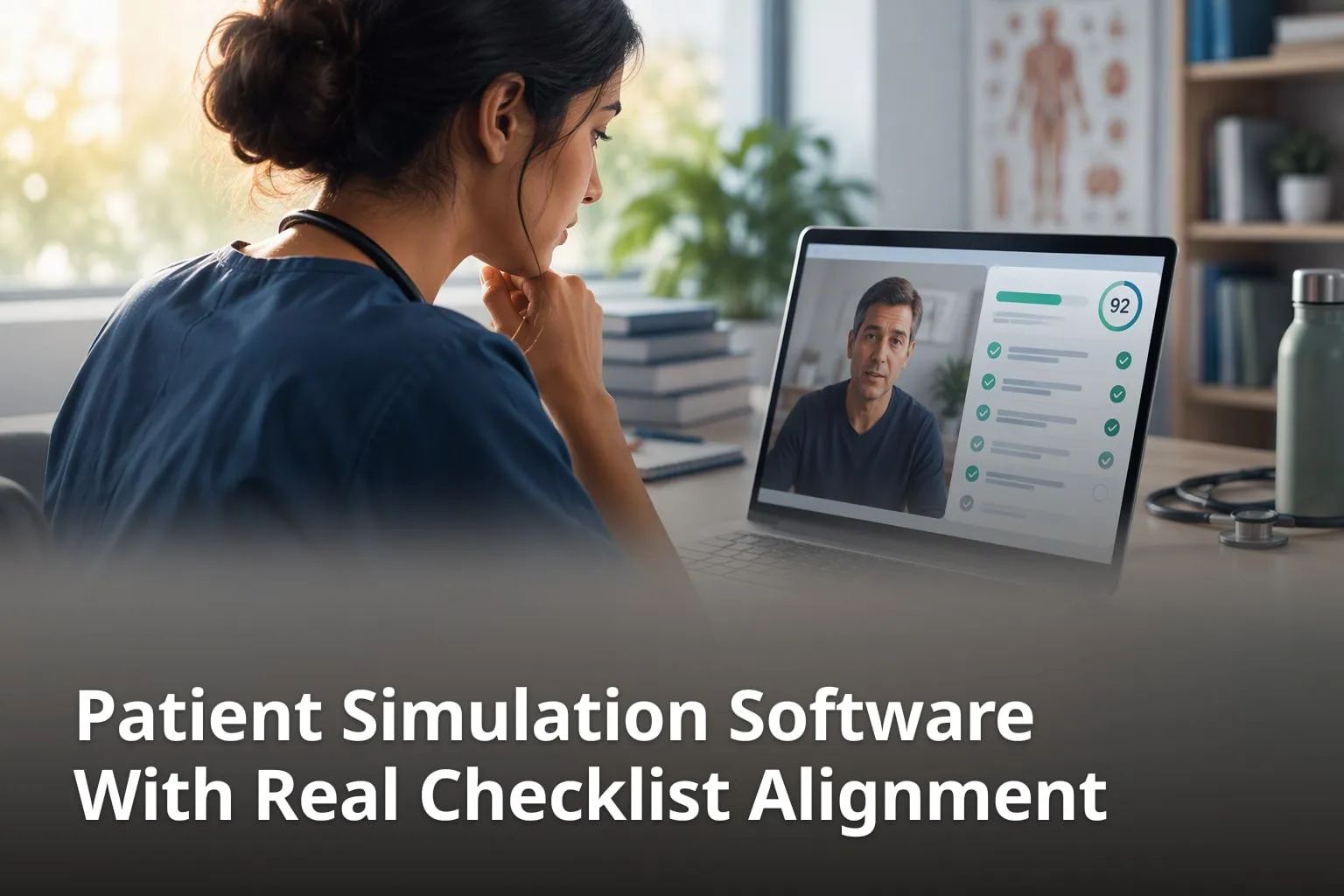
For medical students preparing for Objective Structured Clinical Examinations (OSCEs), patient simulation software with real checklist alignment is a powerful tool. It bridges the gap between theoretical knowledge and practical implementation by offering realistic scenarios evaluated against official OSCE checklists. This alignment ensures accurate feedback and boosts confidence for the actual exam.
What is patient simulation software with real checklist alignment?
Patient simulation software with real checklist alignment evaluates clinical practice scenarios against official OSCE checklists. This ensures students receive accurate, standardized feedback that mirrors the rigor of actual clinical assessments. By following these checklists, students not only refine their technical competencies but also develop a deeper understanding of procedural protocols and patient safety measures. Such alignment eliminates guesswork, allowing learners to internalize the specific expectations they will face in real-world examinations and fostering a systematic approach to patient care.
What are the key details to consider?
- Simulates realistic patient interactions for OSCE preparation.
- Aligns with official OSCE history-taking checklists.
- Provides precise, item-by-item scoring for every case.
- Helps students identify and address knowledge gaps effectively.
- Improves clinical reasoning and decision-making skills.
For example, Klinico's AI patient simulator allows medical students to engage in natural history-taking conversations. Every interaction is scored against the OSCE checklist, covering 27 out of 33 items. This rigorous evaluation enables students to pinpoint areas for improvement and refine their clinical approach.
Moreover, simulated patients respond in realistic ways, mirroring actual clinical encounters. This feature aids in developing communication skills, critical thinking, and adaptability, essential traits for future healthcare professionals. By focusing on checklist alignment, the software ensures students are not just practicing, but practicing correctly according to the standards they will be evaluated against.
Why is real checklist alignment important in OSCE preparation?
Real checklist alignment ensures that students practice and are evaluated using the same criteria as their actual OSCE exams, boosting confidence and readiness. This consistency allows learners to build familiarity with the exam structure, which significantly reduces anxiety during high-pressure assessments. Furthermore, by aligning practice with real-world criteria, students can identify specific areas requiring improvement, helping them to allocate study time more effectively and ensuring their preparation is both targeted and comprehensive.
What are the key details to consider?
- Replicates the exact OSCE marking standards.
- Prepares students for real-world clinical expectations.
- Reduces surprises during actual OSCE assessments.
- Provides a structured approach to clinical history-taking.
- Encourages focused improvement on checklist-specific areas.
With real checklist alignment, students gain familiarity with the format and expectations of OSCEs. For instance, Klinico scores conversations item by item, highlighting strengths like exploring ICE (Ideas, Concerns, Expectations) and taking full SOCRATES (Site, Onset, Character, Radiation, Associations, Time course, Exacerbating/Relieving factors, Severity). These detailed rubrics provide clarity and direction for improvement.
This structured approach minimizes uncertainty, allowing students to focus on honing their skills. They can track progress across sessions and identify which systems, such as cardiovascular or respiratory, require additional practice. By reducing surprises and aligning with real-world standards, checklist-based simulation fosters confidence and competence in medical students.
How does Klinico implement real checklist alignment?
Klinico uses official OSCE checklists to score every patient interaction, breaking down feedback into strengths and areas for improvement for each checklist item. This ensures that students are practicing according to the standards they will encounter during their clinical exams.
1. Leverage official OSCE checklists for scoring
Klinico integrates the same checklists used in actual OSCE exams to evaluate every patient case. Each checklist item is meticulously reviewed, ensuring that students understand the required standards for history-taking and clinical reasoning.
2. Incorporate SOCRATES and ICE frameworks
Klinico breaks out SOCRATES (Site, Onset, Character, Radiation, Associations, Timing, Exacerbating factors, Severity) and ICE (Ideas, Concerns, Expectations) in its scoring system. This ensures thorough exploration of patient symptoms and their context, as required in professional OSCEs.
3. Provide instant feedback after each session
Students receive real-time feedback detailing their strengths and missed opportunities immediately after completing a case. This allows for immediate adjustments in subsequent practice sessions and avoids delays often associated with manual scoring systems.
4. Track readiness by clinical system
Klinico uses a live scoring system to show progress across different clinical systems, such as cardiovascular or respiratory. This helps students prioritize their practice on areas where they need the most improvement.
5. Ensure alignment with Macleod's standards
All clinical cases are designed to adhere to Macleod's standards, ensuring that students are exposed to realistic scenarios and best-practice guidelines. This alignment helps bridge the gap between theoretical knowledge and practical application.
What are the key details to consider?
- Scores every case against the station's checklist, item by item.
- Includes SOCRATES and ICE frameworks for comprehensive evaluation.
- Provides instant feedback at the end of each session.
- Tracks progress across clinical systems to guide targeted practice.
- Ensures alignment with Macleod's standards for clinical cases.
What makes Klinico unique compared to other tools?
Klinico's focus on real checklist alignment, instant feedback, and progress tracking sets it apart from most alternatives, offering a complete OSCE preparation experience. The platform is designed to simulate realistic clinical interactions while providing actionable insights for improvement.
1. Practice with realistic AI patients
Klinico’s AI patients are programmed to mimic real-life patients, responding naturally to student inquiries. This creates an authentic interaction that mirrors what students face in OSCE exam rooms.
2. Receive detailed rubric-based feedback
Each session concludes with a detailed breakdown of performance based on the OSCE checklist. Students can identify their strengths and weaknesses, ensuring targeted improvements in subsequent practice.
3. Track progress across clinical systems
Klinico’s progress tracking feature enables students to monitor their readiness across various clinical systems. This helps in organizing practice sessions based on individual needs and exam requirements.
4. Access custom cases tailored to OSCE standards
Klinico offers cases written specifically to align with OSCE requirements. These custom cases ensure that students are practicing relevant scenarios and are fully prepared for exam day.
5. Benefit from affordable student pricing
With a Student plan available for $10 per month, Klinico provides unlimited access to AI patient cases, detailed feedback, and progress tracking, making it a cost-effective tool for medical students preparing for OSCEs.
What are the key details to consider?
- Realistic AI patients simulate natural conversations.
- Detailed rubric-based feedback after every session.
- Progress tracking across clinical systems.
- Custom cases written to align with OSCE standards.
- Affordable pricing tailored for medical students.
How does instant feedback improve OSCE preparation?
Instant feedback allows students to immediately understand their strengths and weaknesses, enabling focused improvement for their next practice session. This real-time evaluation bridges the gap between effort and results, fostering continuous learning. For instance, if a student struggles with patient communication, they can quickly adjust their approach and practice again, reinforcing positive habits. This iterative learning model not only accelerates skill acquisition but also builds the confidence needed to handle unpredictable scenarios during exams or clinical practice.
1. Review checklist items immediately after each practice session.
When a session ends, feedback highlights missed checklist items, helping students pinpoint exactly where they fell short. This eliminates the uncertainty of waiting weeks for evaluation and ensures they can address specific gaps immediately.
2. Use actionable insights for targeted learning.
Feedback on strengths and areas for improvement provides actionable insights, allowing students to focus their next practice session on weak areas. This targeted learning approach maximizes the efficiency of their preparation.
3. Encourage iterative learning and skill refinement.
Instant feedback promotes iterative learning by enabling students to refine their skills continuously. By practicing repeatedly and applying feedback, they build competence over time and improve their readiness for real OSCE scenarios.
4. Track measurable progress to boost confidence.
With each session, students can see their scores improve, reflecting measurable progress. This boosts their confidence, reassuring them that their preparation is effective and their skills are improving ahead of their OSCE.
Tip: Reviewing feedback immediately after practice ensures that corrections are fresh in your mind, which leads to faster and more effective adjustments.
What clinical systems can students practice with Klinico?
Klinico offers cases across multiple clinical systems, including cardiovascular, respiratory, gastrointestinal, and musculoskeletal, with more systems being added over time. This variety ensures students can prepare comprehensively for the diverse challenges of OSCEs. By engaging with a wide range of cases, learners are exposed to an array of clinical presentations, enhancing their diagnostic abilities and critical thinking skills. This comprehensive approach not only prepares them for exams but also equips them with the versatility needed for real-world medical practice, where conditions often overlap and require a holistic understanding.
1. Practice history-taking in cardiovascular cases.
Students can work through cardiovascular cases that simulate common presenting complaints like chest pain. These cases are meticulously aligned with Macleod’s clinical standards to ensure high-quality preparation.
2. Explore respiratory system scenarios.
Respiratory cases, such as breathlessness history-taking, allow students to navigate nuanced scenarios. These sessions are designed to build confidence in diagnosing and addressing respiratory complaints.
3. Dive into gastrointestinal case studies.
Students can practice gastrointestinal cases like abdominal pain history-taking. These scenarios help hone their ability to identify red flags and establish a clear clinical picture.
4. Work on musculoskeletal cases.
Musculoskeletal cases, such as joint pain history-taking, add depth to the learning experience. These cases prepare students to address orthopedic issues confidently in the OSCE setting.
Note: Klinico is expanding its offerings to include physical examination and imaging modules soon, broadening the scope of practice opportunities.
How does Klinico track student progress?
Klinico tracks progress by providing live scores for each clinical system and highlighting areas needing improvement, helping students prioritize their practice effectively. This feature ensures that students can allocate their time to areas that require the most attention, ultimately optimizing their study efforts and building clinical competence.
1. Review live scores after every session
After completing a case, Klinico provides a live score broken down by clinical system. This immediate feedback allows students to see how they performed and identify systems they excelled in or need to improve further. The real-time nature of the feedback eliminates guesswork, helping students focus on actionable improvements.
2. Analyze strengths and weaknesses
Feedback includes a detailed breakdown of strengths, such as effective history-taking techniques and areas where essential checklist items were missed. This granular analysis helps students focus on specific skills they need to refine. For example, if a student consistently misses asking about certain symptoms, they can adjust their approach in subsequent sessions.
3. Track progress across multiple sessions
Klinico enables students to monitor their development over time. By comparing their scores from previous sessions, they can measure their improvement and set new goals for future practice. This longitudinal tracking fosters a sense of achievement and helps students understand the effectiveness of their study strategies.
4. Focus on weaker areas
The platform encourages targeted practice by highlighting weaker areas in each clinical system. Students can allocate more time to improving these aspects, ensuring a well-rounded readiness for OSCE exams. For instance, if a student struggles with respiratory cases, they can prioritize practicing scenarios within that system.
Use progress tracking to identify trends over time. Regularly revisiting systems with lower scores can significantly improve performance before the OSCE.
What are the key details to consider?
- Live scores for each clinical system after every session.
- Detailed breakdown of strengths and weaknesses.
- Progress tracking across multiple practice sessions.
- Encourages focused improvement on weaker areas.
- Helps students build confidence in their OSCE readiness.
How affordable is Klinico for medical students?
Klinico offers flexible pricing, starting with a free trial and an affordable $10/month plan that includes unlimited cases and detailed feedback. This pricing structure is designed to accommodate the financial constraints of medical students while providing comprehensive resources for OSCE preparation.
1. Explore the free trial
Students can try Klinico free of charge, gaining access to limited AI patient cases, voice conversations, and basic feedback. This trial helps users understand the platform’s functionality before committing. It’s an excellent way to gauge how well Klinico aligns with their study goals and routines.
2. Upgrade to the $10/month plan
For $10/month, students unlock unlimited AI patient cases, detailed rubric-based feedback, and progress tracking. This plan was designed to be accessible and affordable for medical students. The value offered at this price point makes it a compelling choice for individual learners aiming to maximize their OSCE preparation.
3. Benefit from custom institutional pricing
Institutions can opt for custom pricing plans tailored to their needs. These plans provide cohort seats for student groups, faculty dashboards, and cases aligned with specific curriculums. Such options ensure that medical schools can integrate Klinico seamlessly into their existing training programs.
Use the free trial to assess whether Klinico aligns with your study habits before upgrading to the full plan.
What are the key details to consider?
- Free trial available for students to explore the platform.
- Affordable $10/month plan for unlimited practice cases.
- Includes detailed rubric-based feedback and progress tracking.
- Custom pricing options for institutions and medical schools.
- Accessible pricing designed with students in mind.
What is Klinico?
The platform is an AI patient simulator designed for OSCE history-taking practice. It provides realistic patient interactions and scores each session against the official OSCE checklist. This ensures that students are evaluated on criteria they will encounter during their exams.
How does Klinico provide feedback?
The platform delivers instant feedback at the end of each session, highlighting strengths and areas for improvement based on the OSCE checklist. Students can quickly understand their performance and adjust their strategies accordingly.
Can I track my progress with Klinico?
Yes, Klinico tracks your progress by providing live scores for each clinical system and showing areas where you need more practice. This feature is invaluable for building confidence and ensuring comprehensive preparation for OSCEs.
What clinical systems are available on Klinico?
The platform offers cases in cardiovascular, respiratory, gastrointestinal, and musculoskeletal systems, with more systems like physical examination and imaging coming soon. This diversity ensures that students can practice a broad range of clinical scenarios.
Is Klinico affordable for students?
Yes, Klinico is designed for students with a free trial and an affordable $10/month plan that includes unlimited cases and detailed feedback. This low-cost option ensures that students receive quality training without financial strain.
Does Klinico support institutions?
Yes, Klinico offers custom plans for institutions, including cohort seats, faculty dashboards, and curriculum-specific cases. These features are tailored to meet the unique needs of medical schools and training programs.
What are the sources?
Which sources support these claims?
- Klinico, https://www.klinico.co/pricing
- Klinico, https://www.klinico.co/features
- Klinico, https://www.klinico.co/
- Grand View Research, https://www.grandviewresearch.com/industry-analysis/medical-healthcare-simulation-market
- Markets and Markets, https://www.marketsandmarkets.com/Market-Reports/medical-simulation-software-market-95728725.html